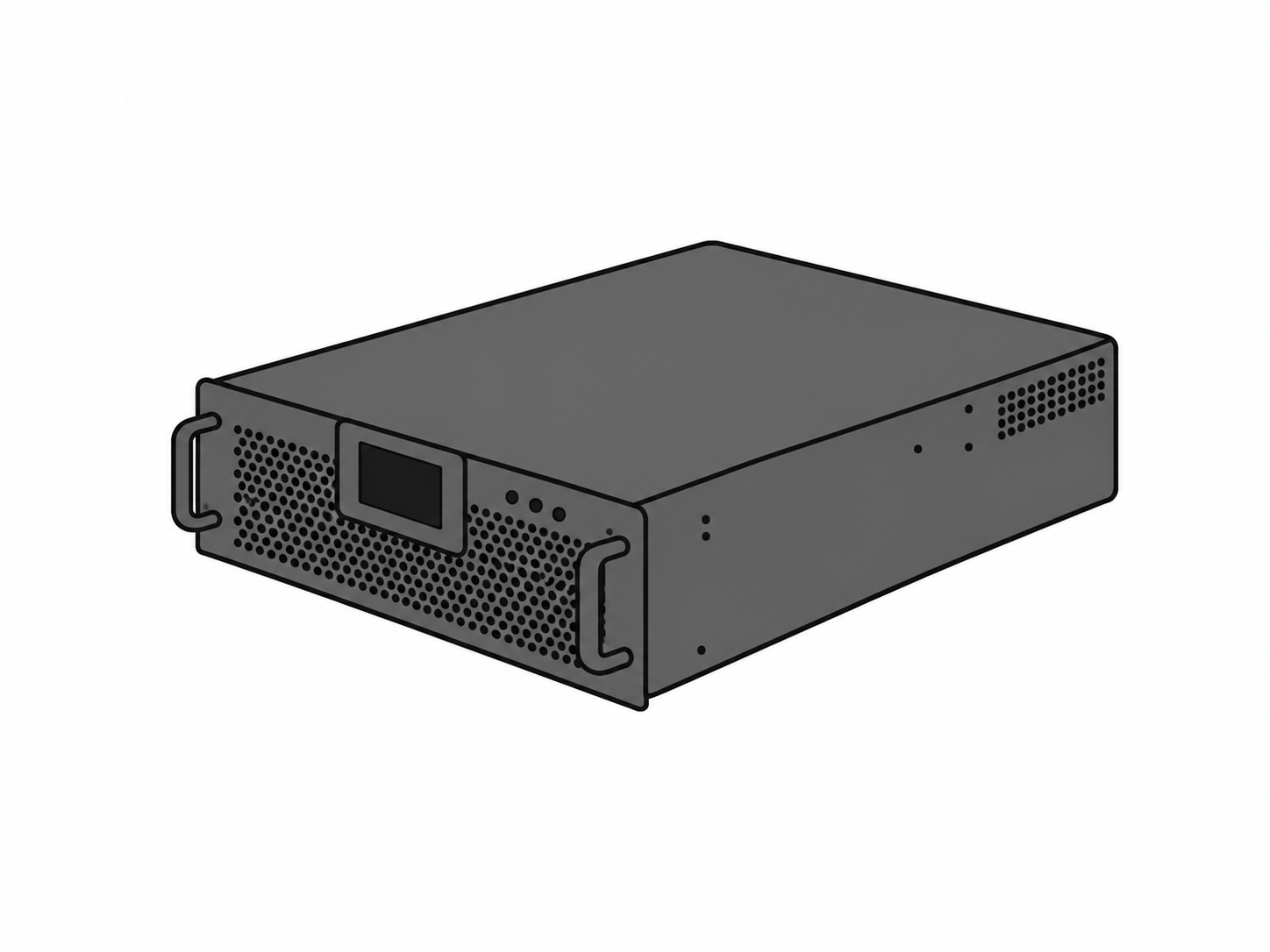
The active harmonic filter (AHF) has always been limited by the switch it is built on. For decades that switch was the silicon IGBT — effective, but bounded by silicon's physics. Silicon carbide (SiC) MOSFETs change the ceiling. This article quantifies what the wide-bandgap material actually buys an LV AHF, and where the conventional IGBT still earns its place.
The IGBT ceiling
A conventional LV AHF uses IGBTs rated to a 150°C junction, switching typically under 20 kHz.
• Bandwidth limit: the canceling current is synthesized at f_sw; the higher harmonic orders (13th, 17th, 25th…) the filter can cleanly reach are bounded by how fast it switches.
• Thermal cost: switching loss rises with frequency. To stay under the 150°C cap, the designer adds heatsinks and fans, which makes the cabinet bulky and ties reliability to moving parts.
What SiC actually changes
• Bandgap: 3.26 eV vs silicon's 1.12 eV — fundamentally higher.
• Junction temperature: rated to 200°C, versus 150°C for IGBT.
• Breakdown field: roughly 10× silicon, so thinner drift layers and lower R_ds(on).
• Switching frequency: 2–3× the IGBT for the same loss budget.
• Switching loss: roughly 50% lower, which also lifts efficiency by 1–3%.
The payoff for an AHF
1. Wider cancellation bandwidth. Higher f_sw means 13th-order and above are handled too — the difference between partial and full cleanup on a bus dense with SMPS.
2. Smaller, cooler cabinet. Lower loss and a 200°C junction shrink the thermal system; same kVAr in less footprint.
3. Efficiency. 1–3% less loss is the AHF's own operating cost removed.
4. Reliability. Cooler operation extends component life and lets fans run slower.
The correction law is unchanged: i_c* = i_L − i_s(fundamental) — SiC just lets it be executed faster and over a wider band, tracking the load within < 1 ms and pulling THDi from 30%+ down to < 5% across more orders at once.
When the IGBT still wins
This is not a wholesale replacement. In standard industrial settings with a predictable harmonic profile and where first-cost dominates, a conventional IGBT AHF remains a robust, cost-effective choice. SiC earns its premium where space, long-term energy savings, and high-order performance are the constraint — dense data centers, compact switchrooms, and buses with fast-switching nonlinear load.
Bottom line
SiC does not make the IGBT AHF obsolete; it raises the performance ceiling for the cases that need it. CHITEK's LV AHF platform is built around this IGBT→SiC upgrade path — same correction principle, wider bandwidth, smaller footprint, cooler run.
What's the highest harmonic order your bus is actually generating — and is your AHF rated to cancel it?
CHITEK Technical Team
4 min read