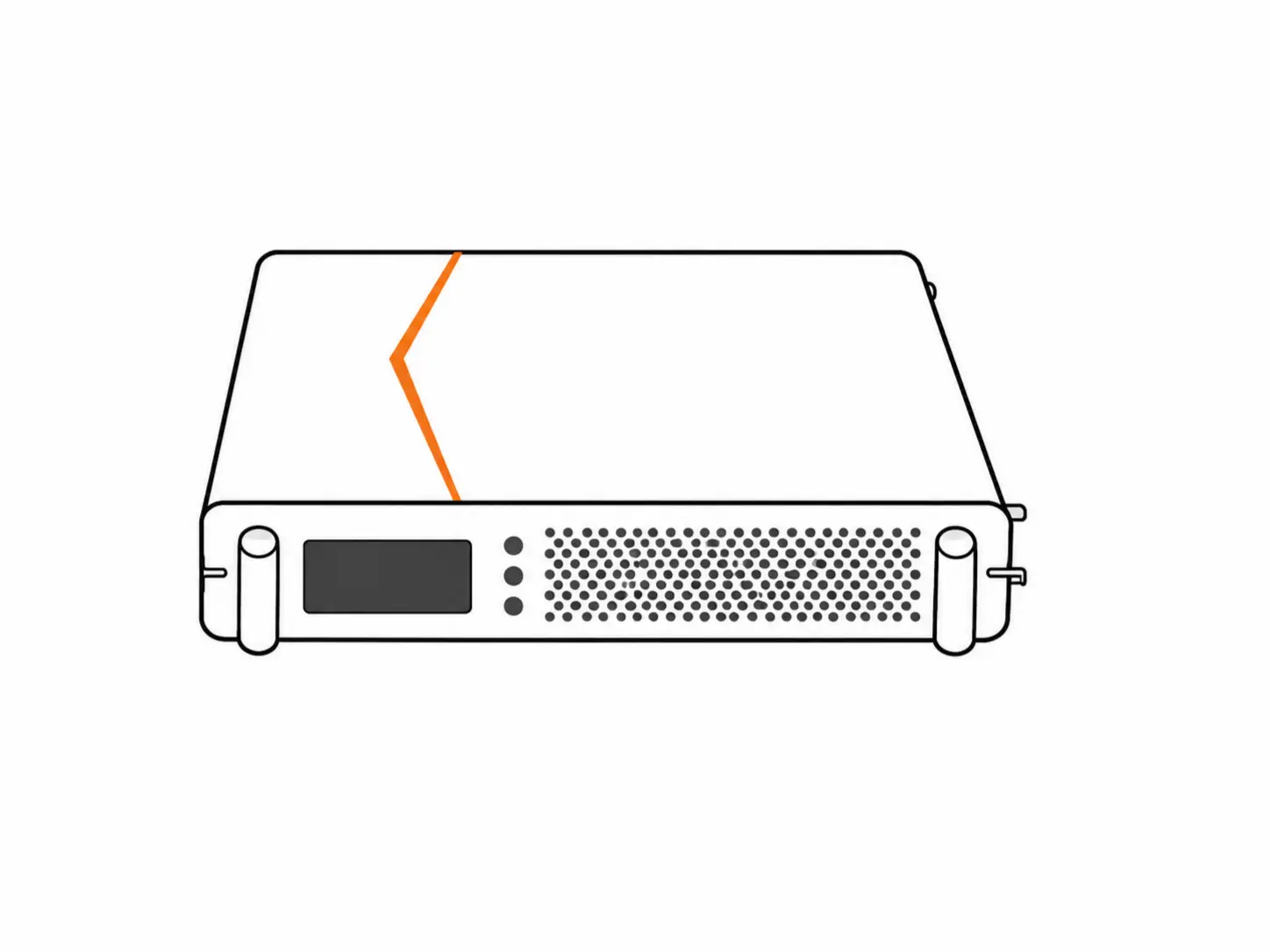
THDi (total harmonic distortion of current) quantifies how far a current waveform has strayed from a pure sinusoid because of harmonics. It is the single number that decides whether a low-voltage (LV) bus meets IEEE 519 — and whether your transformers and cables are quietly overheating. This article explains what THDi is, where it comes from, what it costs, and how an active harmonic filter (AHF) cancels it.
What THDi Is
Harmonics are current and voltage components at integer multiples of the fundamental (50 or 60 Hz). THDi is the RMS sum of those harmonics divided by the RMS fundamental, expressed as a percentage:
THDi = √(Σ I_h²) / I_1 × 100%
Below about 5% the waveform is close to ideal; above about 20% it is severely distorted. IEEE 519 caps LV THDi < 5% (individual harmonics < ~3%) at the point of common coupling (PCC).
How THDi Happens
The cause is nonlinear loads — devices that draw current in abrupt pulses rather than smoothly. Common sources include:
- Variable-frequency drives (VFDs)
- LED lighting
- Computers and office equipment
- UPS systems
- Switch-mode power supplies
- Battery chargers and EV chargers
A six-pulse rectifier — the front end of most VFDs and UPS units — generates characteristic harmonics at orders n = 6k ± 1: the 5th, 7th, 11th, and 13th. Left untreated, THDi at the load often sits between 8% and 30%.
What High THDi Costs
- Overheating — harmonic current raises I²R loss in cables and transformers with the square of current, so they age faster.
- Reduced power factor — distorted current lowers true PF, raising apparent power and the bill.
- Equipment malfunction — PLCs, sensors, and communications error out on a distorted bus.
- Protective-device interference — breakers and fuses misoperate on a distorted waveform.
- Resonance — harmonic current can resonate with system capacitance and inductance, amplifying voltage.
How to Reduce THDi
- Passive filters — tuned to block specific orders; economical for fixed spectra but resonance-prone.
- AHF — dynamically injects counter-current to cancel distortion in real time.
- K-rated transformers and line reactors — help hardware survive harmonics.
- Load balancing — cuts neutral current and the associated triplen harmonics.
- Low-THD equipment — complying with IEEE 519 and IEC 61000-3-2 at the source.
The AHF Fix
An AHF samples the load current, separates the fundamental from the distortion, and injects the inverse:
i_c* = i_L − i_s(fundamental)
Synthesized by a bridge switching at 15–20 kHz, it tracks within < 1 ms and pulls THDi from 30%+ down to < 5% across the 5th through 25th orders simultaneously. It also compensates reactive current and helps balance phases, with no resonance risk.
IGBT vs SiC
Most LV AHFs use IGBTs with a junction capped near 150 °C. Silicon-carbide (SiC) MOSFETs widen the bandgap (3.26 eV vs 1.12 eV), tolerate 200 °C, switch at 2–3× the frequency, and cut switching loss by roughly 50% — a smaller, cooler cabinet with headroom for higher orders. That is the direction CHITEK's LV AHF platform is built on.
Engineering Deployment Checklist
- Measure at the PCC over a full duty cycle with a power-quality analyzer.
- Place the AHF at the source — on the feeder feeding the nonlinear cluster.
- Audit capacitor banks for resonance before commissioning.
- Size on measured TDD referenced to peak demand.
- Leave headroom (15–25%) for added load.
Bottom Line
THDi is the number that tells you whether your bus is clean or quietly degrading. A low-voltage AHF cancels the distortion at the source — measurably, within IEEE 519. CHITEK’s LV AHF platforms are specified from exactly this measurement-first discipline.
What THDi is your bus actually logging — and is it under 5% at the PCC?
CHITEK Technical Team
5 min read